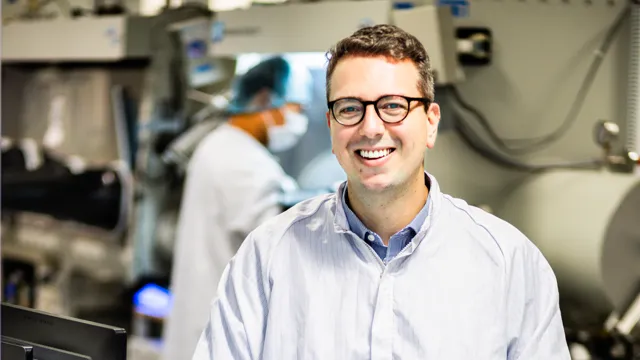
Through a long application process, Alex Gillett finally received funding from The Knut and Alice Wallenberg Foundation to come to Link枚ping University. Here, he will set up his own ultrafast optical spectroscopy lab.
鈥淚 will be able to shoot samples with very, very short pulses of light, a millionth billionth of a second鈥�, he says.
In doing so, he hopes to study how materials work and understand their useful behavior, like generating electricity in a solar cell or converting electricity back to light in a light-emitting diode. Through this knowledge, he will then design new materials.
鈥淭he short laser pulse duration is on a similar timescale to the movement of electrons in a material, which will allow me to study how solar cell and light-emitting diodes work on the fastest timescales鈥�, he says.
Explaining his curiosity in understanding materials further he gives an example, a recent interest in how vibrational couplings work in a material.
鈥淚magine a molecule, made of atoms and chemical bonds. Just sitting there, it is not stationary, but vibrating and moving around at fixed frequencies determined by the structure of those atoms. These vibrations and motions can control how the material behaves, for example if it emits light or absorbs light. I'm very interested in learning how these vibrations and movements can drive the key processes that underpin how a material functions in a device鈥� he says.
The lab, and Alex Gillett, will be a part of the materials research at the Department of Physics, Chemistry and Biology, at LiU. Dr. Gillett found Link枚ping via Professor Feng Gao, already active at LiU in his own research group.
鈥淚 know Professor Feng Gao through previous collaborations. I met with him again at a conference a couple of years ago and he suggested that I should apply for the Wallenberg Academy Fellows grant. I really like the research environment here at LiU. It is very open, has lots of good infrastructure, and there are many people working in similar areas to me with whom I can collaborate with鈥�, he says.
The Wallenberg grant will provide him with the resources to set up his ultrafast optical spectroscopy lab and also hire personnel to start his research group.
鈥淚 will hire postdocs and PhD-students. Hopefully, from there, I will be able to obtain more funding grants and grow the group to be bigger in the next few years.鈥�
鈥淚 will be able to shoot samples with very, very short pulses of light, a millionth billionth of a second鈥�, he says.
In doing so, he hopes to study how materials work and understand their useful behavior, like generating electricity in a solar cell or converting electricity back to light in a light-emitting diode. Through this knowledge, he will then design new materials.
鈥淭he short laser pulse duration is on a similar timescale to the movement of electrons in a material, which will allow me to study how solar cell and light-emitting diodes work on the fastest timescales鈥�, he says.
Explaining his curiosity in understanding materials further he gives an example, a recent interest in how vibrational couplings work in a material.
鈥淚magine a molecule, made of atoms and chemical bonds. Just sitting there, it is not stationary, but vibrating and moving around at fixed frequencies determined by the structure of those atoms. These vibrations and motions can control how the material behaves, for example if it emits light or absorbs light. I'm very interested in learning how these vibrations and movements can drive the key processes that underpin how a material functions in a device鈥� he says.
The lab, and Alex Gillett, will be a part of the materials research at the Department of Physics, Chemistry and Biology, at LiU. Dr. Gillett found Link枚ping via Professor Feng Gao, already active at LiU in his own research group.
鈥淚 know Professor Feng Gao through previous collaborations. I met with him again at a conference a couple of years ago and he suggested that I should apply for the Wallenberg Academy Fellows grant. I really like the research environment here at LiU. It is very open, has lots of good infrastructure, and there are many people working in similar areas to me with whom I can collaborate with鈥�, he says.
The Wallenberg grant will provide him with the resources to set up his ultrafast optical spectroscopy lab and also hire personnel to start his research group.
鈥淚 will hire postdocs and PhD-students. Hopefully, from there, I will be able to obtain more funding grants and grow the group to be bigger in the next few years.鈥�